
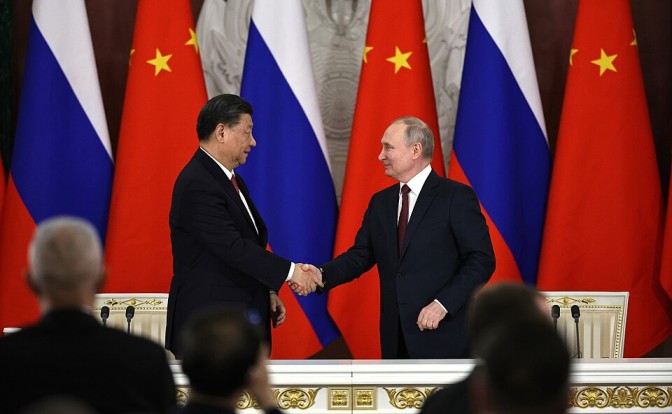
In a significant development, Chinese President Xi Jinping and Russian President Vladimir Putin have agreed to extend the China-Russia Treaty of Good-Neighborliness and Friendly Cooperation. The decision was made during Putin’s state visit to China, with both leaders emphasizing the enhancement of political mutual trust, strategic coordination, and practical cooperation amidst a volatile global landscape. The discussions, held at the Great Hall of the People in Beijing, culminated in the signing of a joint statement to deepen the comprehensive strategic partnership and foster good-neighborliness between the two nations.
The meeting between Xi and Putin marked a continuation of their longstanding diplomatic relationship, as demonstrated by Putin’s 25th visit to China since assuming office in 2000. The leaders signed a series of 20 cooperation documents covering diverse fields such as the economy, trade, education, and science and technology. They also issued a joint statement advocating for a multipolar world and a new type of international relations. Xi highlighted the 30-year milestone of the China-Russia strategic partnership and underscored the treaty’s principles of non-alliance, nonconfrontation, and mutual respect, which have guided bilateral relations.
Xi emphasized the need for China and Russia to build on their past achievements and support each other on core interests while maintaining close strategic communication. Bilateral trade has surpassed $200 billion for three consecutive years, with a notable 20 percent increase in the first four months of 2026. The two countries aim to align China’s 15th Five-Year Plan with Russia’s 2030 development strategy, enhancing cooperation across various sectors to support national development and revitalization.
Discussing global governance, Xi pointed out the dangers of unilateralism and hegemonism, stressing the importance of upholding UN authority and international fairness. As permanent members of the UN Security Council, China and Russia commit to opposing unilateral bullying, and both leaders emphasized resisting any attempts to justify fascism and militarism. Putin expressed confidence in the future of Russia-China relations, describing them as unprecedented and self-sufficient, independent of the international climate. He reiterated the commitment to uphold international law and collaborate within frameworks like the Shanghai Cooperation Organization and BRICS.
Additionally, both countries announced extensions of their respective visa-free policies until the end of 2027, facilitating easier travel for citizens. During their discussions, Xi and Putin also addressed pressing international issues, particularly the Middle East conflict, advocating for an end to hostilities and continued negotiations to stabilize energy supplies and maintain global trade order. The dialogue between the two leaders signifies a strategic choice to promote long-term, stable, and high-quality development of China-Russia relations, leveraging comprehensive cooperation mechanisms to foster growth and mutual trust.