
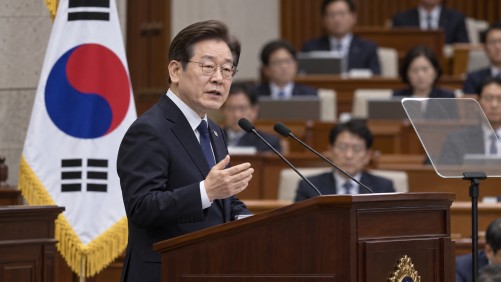
South Korean President Lee Jae Myung is advocating for a constitutional amendment to formally acknowledge the country’s pivotal pro-democracy movements. Speaking at an event in Busan on Friday to commemorate the 47th anniversary of the 1979 Buma uprising, Lee urged the National Assembly to initiate discussions on this reform. The Buma uprising, along with the May 1980 Gwangju Democratization Movement, were highlighted by Lee as crucial milestones in the nation’s democratic evolution.
President Lee emphasized the significance of embedding these historic events into the Constitution’s preamble, arguing that such recognition would honor those who bravely defied authoritarian rule and reinforce the principle of popular sovereignty. He paid tribute to the protesters who risked their lives for democratic ideals, describing their efforts as foundational to South Korea’s democratic development.
Beyond preserving historical legacy, Lee called on lawmakers from both ruling and opposition parties to engage in public consultations and pursue meaningful constitutional reform. He stressed the importance of ensuring that future generations are spared the need to make similar sacrifices to safeguard democracy.
Lee has consistently supported revising the Constitution, which was last amended in 1987. His broader reform agenda includes changing the presidential term structure from a single five-year term to two consecutive four-year terms. Although a previous constitutional amendment proposed by the ruling Democratic Party of Korea failed in May, Lee believes that acknowledging the country’s democratic movements could provide common ground for renewed dialogue.
The Buma uprising, which started on October 16, 1979, at Pusan National University and subsequently spread to Masan and surrounding areas, is widely seen as a turning point in South Korea’s democratic transition. The authorities responded with arrests, martial law in Busan, and military action against protesters. Lee asserts that constitutional recognition of such events would help cement the principle that political power must remain accountable to the people.